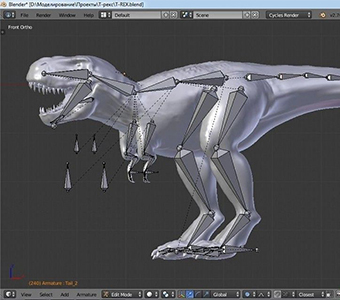
There’s nothing quite like seeing your creations come to life on screen, and for 3D animators, their lifelike objects, characters, and settings are just about as close to reality as you can get. With today’s rapidly changing technology, though, it’s easy to forget 3D animation hasn’t always been the standard for video games, films, and TV shows. Here, we’ll take a look at its history, including a few famous examples, and think about what the future might hold for this digital art form. No matter what kind of animation we’re talking about, it’s the process of creating a static image that looks like it’s moving. 3D animation takes things one step further by making that image three-dimensional. The characters and objects have depth and look more realistic within their digital world, instead of looking “flat” like you’d find in 2D animation. How does animation work? Animators start by creating still images that are broken down into frames, or one single complete image. When the frames are added together and played in a sequence, our eyes and brains are tricked into thinking the image is moving. To create the illusion of movement, images need to be displayed at 12 frames per second or faster. For classical animators who draw by hand, 15 frames per second is the industry standard for creating the cartoon look we all know and love. But for those using 3D animation software, 24 frames per second is common. Most 3D animations are created using a virtual skeleton known as a rig, which gives the animator the rough outline of the character or shape they’re designing. From there, individual pieces of the skeleton can be tweaked in each frame so that, when placed in the sequence, the body parts appear to move. Who Invented 3D Animation and When? It’s difficult to answer this specific question, since it really depends on the specific type you’re talking about. Claymation, where clay models of objects are made and manipulated frame-by-frame, dates back to the early 1900s. If you’re familiar with the stop motion techniques used in claymation (think Wallace and Gromit or Coraline), 3D animation is essentially the digitized version of this animation style. If we’re talking about computer animation, the adoption of computer generated imagery, or CGI, the 1960s was the beginning of the 3D animation styles we know today. William Fetter, an employee of Boeing, is often credited as the inventor of computer-generated 3D graphics. His short films of rigged pilots, used for testing their ability to reach aircraft controls, are some of the earliest forms of 3D moving imagery. A Brief History of 3D Animation While 2D animation has been around since the 1800s, three-dimensional graphics developed with the move toward fully computerized graphics in the middle of the 20th century. The Early Days of 3D Animation Throughout the late 1960s and 1970s, computer scientists worked on learning how to animate in 3D for bigger projects. Designers Edwin Catmull (who would go on to co-found Pixar) and Frederic Parke were some of the first to create realistic human hands and faces on wireframed digital rigs. Their techniques were used on film for the first time in the 1976 movie Futureworld. Software continued to be refined throughout the 1980s, and 3D animation became the go-to medium in the early 1990s. Veggie Tales was the first fully 3D animated series in the United States in 1993, and Hollywood blockbusters Terminator 2 (1991) and Jurassic Park (1993) both used the style extensively. By 1995, 3D animation took on its biggest challenge yet: a full-length feature film. That year, Pixar released Toy Story, and the movie claimed the title of the first-ever completely computer animated movie. 3D Animation in Recent History Since the 1990s, CGI and 3D animation methods have continued to evolve, creating special effects in almost every film and television show that exists today. Movies like Avatar (2009) and Disney’s new “live action” remakes of classic 2D films now rely heavily on combining 3D animation with human actors.Recently, we’ve reached the age of photorealism and 4D animation, where the graphics are so clearly defined, it’s often hard to distinguish whether they’re computer generated or real-life. The Future of 3D Animation As with most technology, knowing what the future holds is difficult to predict. It’s hard to imagine 3D animation becoming even better than it already is! But the rise of virtual reality (VR) and augmented reality (AR) shows how much it is already evolving. As we’ve seen in recent years, it’s likely 3D animation will become even more mainstream and be used for business and in everyday communication. Now, you’re just as likely to see a brand using animation in their marketing as you are a new animated television show. It’s also probable that machine learning—in which an input is assessed by a computer and a relevant output is automatically created—will help animators speed up their workflows. And with all that time back in their workdays, we’re likely to see even more animated content hitting our screens. At the time of Toy Story’s creation, Pixar was still a startup run by Steve Jobs and a team of graphic designers who had never created anything in 3D beyond short films and commercials. They managed to pull it off—and the film made over $360 million during its time in theaters. This popular action-adventure video game uses highly detailed 3D graphics to bring the characters and scenery to life. Players view events from a third-party perspective within a fictional historic world and take part in missions and quests before attempting the final assassination of the enemy. World-leading audiobook brand Audible teamed up with a visual effects company to add 3D animation to the 2018 commercial, I Am What I Hear. In less than 30 seconds, we see three-dimensional graphics overlaid on human actors, representing the knowledge and enjoyment gained by listening to an audiobook. This is a great example of how brands are building 3D animation into marketing campaigns. Learn How to Animate in 3D While perfecting the art of this style of animation takes years, getting started on your own projects is the best way to learn. If you’re feeling inspired to create, there’s no better time to take a class and build a 3D character of your own. If you’re an aspiring animator, learning how to use Maya animation software is a must. The software’s extensive features makes it easy to create impressive 3D models and animations. Plus, Maya is commonly used across the film, video game, and TV industries, so with Maya expertise, you’ll open yourself up to a wide variety of career opportunities. Below, learn more about Maya animation software, including what you can use it for and how it works. What Is Maya Animation Software? Autodesk Maya powerful software that enables 3D animation, modeling, simulation, rendering, and more. It’s robust and versatile, and many consider it the industry standard for animation. Many well-known feature film studios use Maya, including Blue Sky Studios, Framestore, and Moving Picture Company. In fact, the software has been used to animate award-winning movies such as “Frozen” and “Wreck It Ralph.”